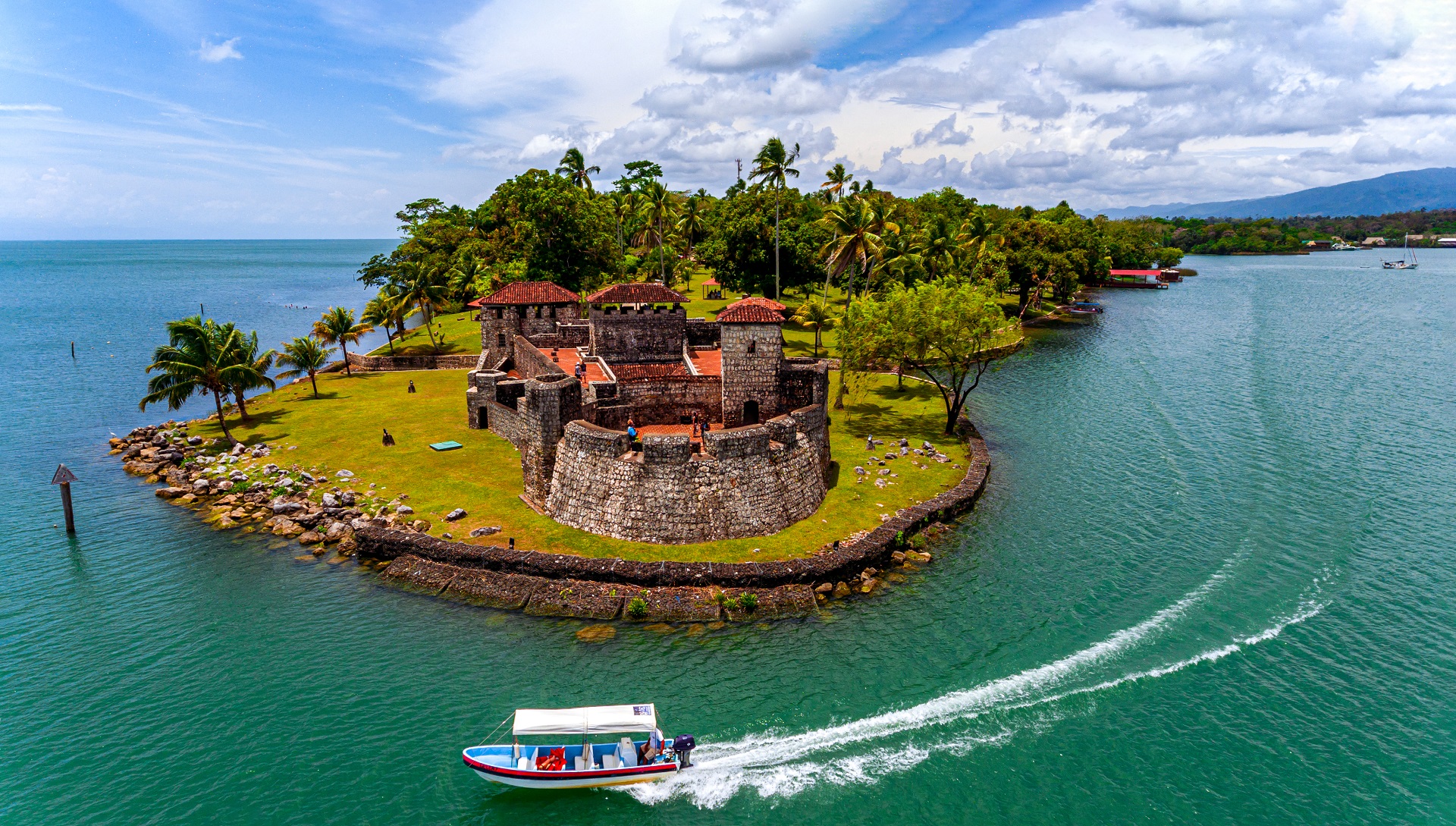
Located amidst the vegetation along the banks of the Río Dulce, Castillo de San Felipe Lara was built by the Spanish to protect against continuous attacks from English pirates who threatened the Caribbean. It was constructed in the mid-17th century with thatched palm roofs, which were burned down by the pirates in 1686, completely destroying the structure. Later, it was formally rebuilt under the direction of Andrés Ortiz de Urbina.
Dormitories
This fortress has four dormitories, one of which was specifically for the chaplain (priest) and the others for soldiers, who slept in bunk beds. Each room had space for up to 14 soldiers.
Pantry
This was the storage area for food. Today, it is used as a small museum displaying items found in the depths of the lake and river, such as pieces of wooden ships, an ancient anchor from the Spanish era, a road wheel used to transport goods to Antigua Guatemala, and the chain that was stretched from the castle to the other side of the river to prevent enemy ships from entering the storage areas.
Main Courtyard
This was the place where soldiers would form and receive instructions. A minimum of 12 and a maximum of 100 soldiers would gather here.
Old Gate
The old gate (named as such because the bolts and hinges of the original gate are still visible) was closed in 1672 to prevent flooding during the rainy season.
Bell Tower
This location housed a bronze bell with two functions: signaling the military for mass and serving as an alarm when an enemy ship was sighted.
Chapel
Masses were held here, and three niches can be seen, each with an image that was venerated: Saint Philip Neri of Jesus, Our Lady of the Rule (Patroness of Navigators), and Saint Anthony of Padua. On the right side, there is a confessional, and at the back, there is a tunnel that serves as one of two entrances to the prison.
Prison
In 1655, the castle was converted into a prison due to the harsh climate and its fortifications. At the back, small spaces are visible where prisoners (Spanish pirates and their subordinates, and indigenous people who refused to submit to Spanish slavery) were chained. Prisoners were fed only one glass of corn atol per day, leading many to die from hunger and disease, especially when the prison would flood during the rainy season.
Bustamante Tower
In the Bustamante Tower, visitors can observe the narrowest part of the river, where the chain seen in the pantry was placed to control the entrance of vessels coming from the sea. This was a strategic point to attack enemies with cannons, which had a range of only 300 meters. Currently, there are 19 cannons, two of which are made of pure bronze, won in a battle against English corsairs.
Terraces
Here, visitors can see skylights with domes and a trunk with a triangle in the river, indicating the boundary between Lake Izabal and the Río Dulce. Lake Izabal is the largest in Guatemala, measuring 42 km² in length and emptying into the Caribbean Sea.
Last Bastion Tower
This was the place where the commander would observe the actions of the guards and watch for the arrival of pirate ships. Today, this location offers the best view of the surrounding area.
North Tower
This is where the two bronze cannons that belonged to the English corsairs are located. The English crown is visible on the cannons, and the Fleur-de-lis, which was used by the French in their crowns, later adopted by the English and then the Spanish. Inside the circle is a quote in French from an English king that means: «Cursed be the evil that thinks ill of others.» This phrase originated when the king was dancing with a countess when one of her stockings fell. As a gentleman, the king took the time to fix it, while the guests murmured and thought poorly of the awkward situation they had witnessed.
Latonera
This was a tool used to raise the gate. What is currently visible is a replica, as the original was made of wood. The chains seen at the bottom are the originals.
Knights’ Tower or Social Hall
This was the place where officers would gather to plan strategies. There are also barracks where the officers rested.
Bathroom
There was a hole that reached the river, which was used for waste disposal, and the soldiers would wash with water. The hole was sealed for the safety of the inhabitants.
Powder Magazine
This is where gunpowder and cannonballs were stored. Visitors can also see part of the original perimeter wall, made from limestone brought from Gualán, Zacapa, and coral stone extracted from the Caribbean reefs, bound with mud, lime, and sand.
General Information
-
Castillo de San Felipe (Populated Area)
-
Department: Izabal, Municipality: Livingston
-
Latitude: 15.6333 | Longitude: -89
-
Phone: 4795-7494 and 3348-2763
-
Email: castillosf@inguat.gob.gt
-
Hours: Monday to Sunday, from 08:00 to 17:00
Entry Fees for Castillo de San Felipe
-
Adults: Twenty-five Quetzals (Q25.00) per person
-
Children (12 to 17 years old): Ten Quetzals (Q10.00) per person
-
Foreigners (including Central Americans): Seventy-five Quetzals (Q75.00) per persona
Deja una respuesta